Capital gains tax when selling a rental: UK 2026
Should you sell a buy-to-let before the Budget? Practical answers on whether timing helps, which rates apply to individuals vs companies, and how to calculate the gain.
Should I sell a rental property before the Budget in case Capital Gains Tax rates change?
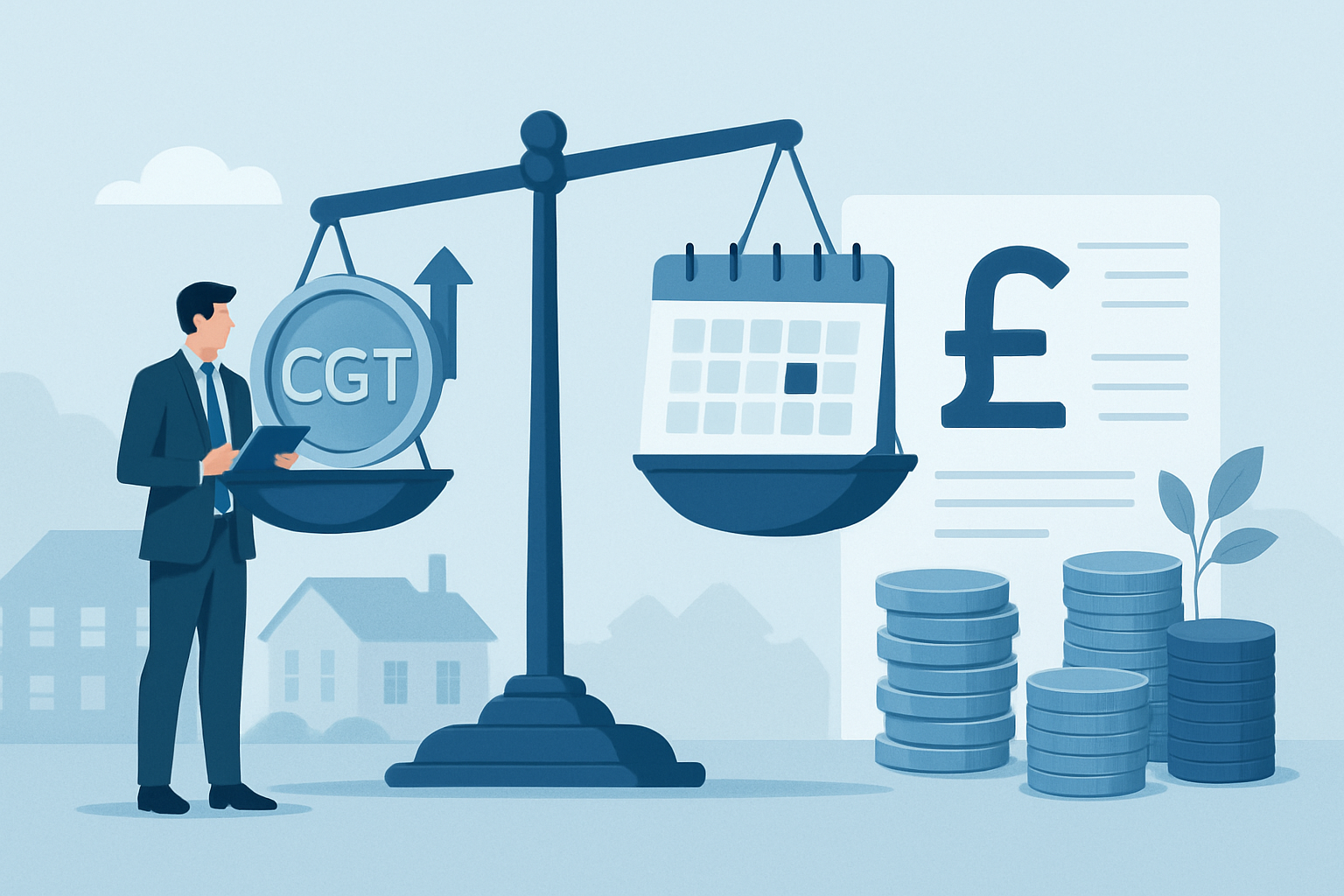
No — in England you should not sell solely to try to beat a Budget because the CGT rate that applies is the law on the date of disposal, so only a sale completed before any rate change uses the earlier rate. The currently published residential CGT rates for individuals are 18% for gains within your unused basic-rate band and 24% on the remainder; changes announced at a Budget become law only if Parliament enacts them and they apply from the dates stated in the legislation. For UK residential disposals you must report and pay any CGT due within 60 days of completion, so the practical question is whether you can actually complete before a change, not whether it was announced. Model the post-tax numbers (including conveyancing and agent fees, SDLT and any withholding or clearance costs) and compare them with likely market movement: selling early to chase a tax headline often costs more in transaction and market-timing losses than it saves. If you want a worked-through tax outcome, get a tax adviser to model your specific dates and figures.
I own eight rental properties through my limited company and one flat in my own personal name — if I sell the personally-owned flat, do I pay 18% or 24% capital gains tax, or does having the company in the mix change anything for that one sale?
If the flat is in your personal name you are taxed as an individual and the company ownership does not change that: you pay residential CGT at 18% on the part of the gain that falls within your unused basic-rate band and 24% on the remainder. The tax charge follows the legal owner who disposes of the asset, so the company’s portfolio is separate — only a disposal by the company would enter the company’s tax computation. To work out which portion of the gain sits in the basic-rate band you must add the gain to your taxable income for the year; any unused basic-rate band can shelter part of the gain at 18% with the remainder at 24%. Remember also to allow for the 60-day reporting and payment rule for UK residential property disposals.
My company owns the rental and wants to sell it — does the company pay capital gains tax the same way I would personally, or does it work completely differently through corporation tax?
It works differently: a company does not pay the individual 18%/24% residential CGT rates — a company treats any chargeable gain as part of its taxable profits and pays corporation tax on that gain under company tax rules. In practice the company computes its chargeable gain, applies any indexation or allowable reliefs that still exist for companies, and includes the result in its corporation tax return; the tax is paid at the company’s corporation tax rate rather than the individual residential CGT rates. If you then extract net proceeds from the company as dividends or salary, separate personal tax consequences arise for you as a shareholder or employee. Because the company is a separate legal and tax person, don’t assume a company sale is the same tax event as a personal sale — get professional advice on corporation tax, potential reliefs, and post-sale extraction strategies before you agree a sale.
How do I actually calculate the capital gain on a rental property I'm about to sell?
Calculate the gain as: sale proceeds minus allowable acquisition and disposal costs minus the purchase price, then subtract any available Annual Exempt Amount and allowable losses to get the chargeable gain. Allowable acquisition and disposal costs typically include Stamp Duty Land Tax paid on purchase, legal fees, estate agent fees on sale, and costs of capital improvements that enhanced the property’s value (but not routine repairs or maintenance). Work in this order: (1) total sale proceeds; (2) less purchase price and acquisition SDLT and fees; (3) less sale costs such as agent and legal fees; (4) add capitalised enhancement expenditure that increased value; (5) deduct any allowable losses carried forward and the Annual Exempt Amount if it remains available; (6) the balance is the taxable gain to which the individual residential rates (18%/24%) apply, or which goes into the company’s corporation tax computation if the company sells. Don’t forget the 60-day residential property reporting and payment deadline for individual disposals; keep detailed invoices and proof for all acquisition, improvement and disposal costs claimed. Abodient’s property-level expense tracking keeps those acquisition, improvement and disposal costs recorded against the property as they’re incurred, so the figures a CGT calculation needs are already there rather than reconstructed at the point of sale. For more on deductible items see our guide on what landlords can claim as expenses and the broader buy-to-let tax round-up for 2026/27.
Timing a sale to a Budget rarely saves more than market movement costs, so most landlords lose more by trying to 'outrun' a tax change than they gain.
Automated property management for UK landlords & property managers
3 months free — no agent fees
Last reviewed August 2026.